


Because “just raise your rates” isn’t a real plan
Most people assume the business side of creativity is just something you figure out as you go — but if that were true, every talented creative would also be profitable (spoiler: they’re not).
You didn’t start your creative business to become a finance bro.
You wanted to design, create, build — not worry about cash flow or gross margins.
But here’s the thing: if you want your business to sustain you (not just emotionally, but financially), then yeah… we need to talk about the money.
This post is your guide to getting a grip on budgeting — without spreadsheets that make your eyes bleed or advice that assumes you run a Fortune 500. Because the business side of creativity matters — and it starts with knowing your numbers.
Why is business planning important
Because winging it works… until it doesn’t.
Especially when it comes to your money.
Business planning isn’t just about setting goals — it’s about knowing what those goals cost, what they’ll make, and how to actually fund the kind of business you want to run.
And that starts with a budget.
A good budget helps you turn dreamy plans into doable numbers.
It shows you what’s possible (and what’s not) — so you’re not just guessing, grinding, and hoping for the best.
With it? You can work less, pay yourself more, and make decisions like the actual boss — not just the one in your Instagram bio. And that’s the real magic of mastering the business side of creativity.
Is a budget necessary?
If you want to get paid, save for taxes, and sleep at night? Yes.
A budget is 100% necessary — even for creatives, even for you.
A budget isn’t just about saying “no” to expenses. It’s about knowing what you can say yes to:
✨ Can you take a month off?
✨ Can you hire that VA?
✨ Can you pay yourself more? Or at all?
✨ Can you take that course you’ve been eyeing on Insta?
If you’ve ever had a “big” month and still felt broke… it’s time for a budget.
This is the foundation of the business side of creativity: understanding what you keep, not just what you make.
Budgeting for your business
Most creative business owners fall into one of two camps:
1️⃣ Spreadsheet avoiders
2️⃣ Spreadsheet hoarders who still feel unclear
The goal isn’t to become a finance expert — it’s to build a system that helps you understand your business well enough to make confident decisions.
Because here’s the thing no one says on those “10K month!!” Instagram posts:
If you made $10K but spent $9K to get there… that’s a 1K month, babe. And that’s before taxes.
Budgeting helps you see what’s really going on — not just how much you made, but how much you kept. It helps you:
- Set income goals that are actually profitable
- Pay yourself like a real human
- Understand your margins (not just your revenue)
- Plan for taxes without panic
- Make intentional, strategic investments
Start by organizing your numbers with a chart of accounts that makes sense for your creative brain — you can download mine for free here.
Budgeting gives you power, not restrictions — and clarity is a whole lot better than vibes when it comes to your money. If you’re serious about growing the business side of creativity, this is where it begins.
How often should you create a budget
The short answer? At least once a year. The better answer? Whenever something big changes.
Every January, I guide my clients through a full budgeting process — setting income goals, mapping out labor (including how to actually pay yourself), and planning expenses for the year ahead.
But life and business don’t always follow a plan.
So if things go way off course — maybe your sales dropped, you pivoted, you grew faster than expected, or your life circumstances shifted — it’s time to rebudget.
I also reopen this budgeting process every June for two types of people:
- The “I meant to do this in January” crew
- The “woah, everything’s changed and I need a reset” folks
TL;DR — Create your budget yearly, revisit it when things change, and don’t wait for the wheels to fall off to take a second look.
Need a hand with yours? My 4-week Budget Intensive is designed to get you clear, confident, and ready to make decisions that actually support your business and your life — and give you a serious handle on the business side of creativity.
What should a business budget include
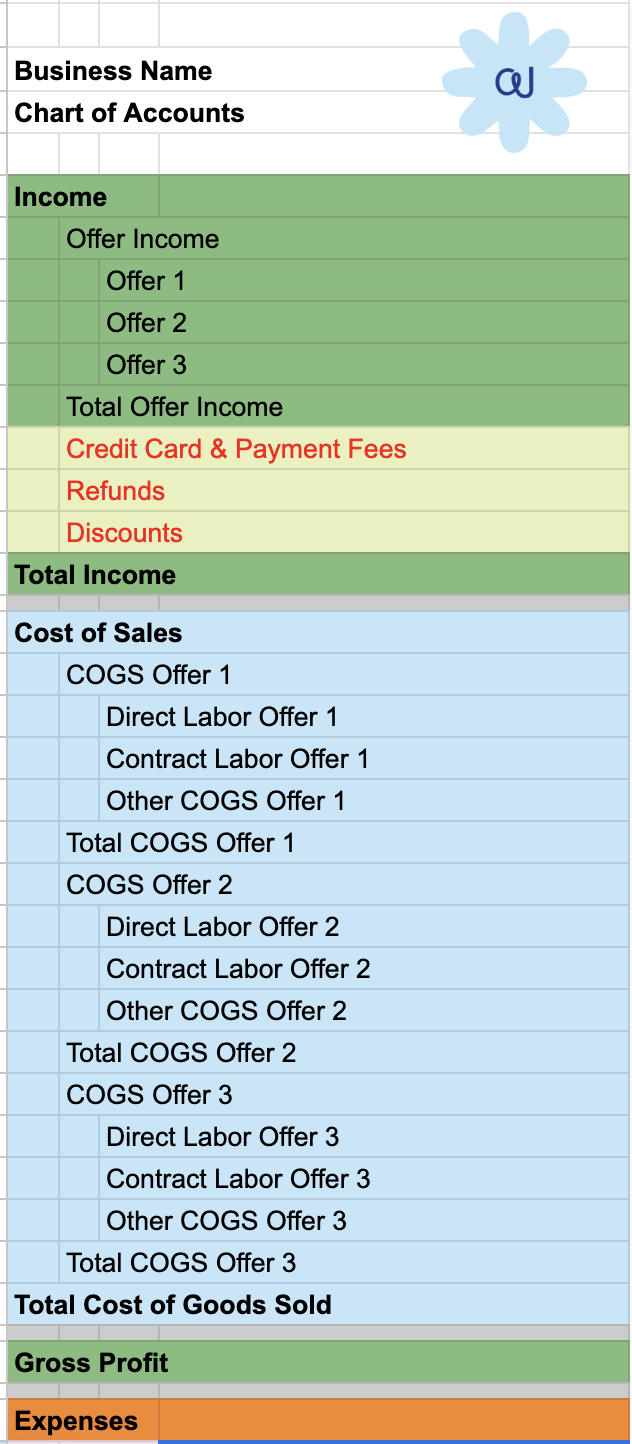
Your budget isn’t just a list of expenses — it’s the structure that lets you track accurately, compare year-over-year, and even benchmark against other creative businesses.
That’s why I don’t just have you throw numbers into one messy spreadsheet.
We set things up in specific categories, and yes — there’s a reason for each one:
- Income – all the money you’re bringing in, broken down by offer, client, or stream
- COGS (Cost of Goods Sold) – anything directly tied to delivering your client work (contractors, printing, hosting, etc.)
- Labor – both hired team and how you pay yourself (yep, you’re part of the budget too)
- General & Admin – the catch-all for behind-the-scenes expenses (software, subscriptions, accountant, etc.)
- Fixed Expenses – recurring costs that don’t change month-to-month (like rent or your CRM)
- Operating – business expenses that support day-to-day work but aren’t tied to a specific project
- Other income / other expenses – where we track things like owner’s draws, online courses, big investments, and capital expenditures
Setting your budget up this way helps you:
✅ Get clear visibility into your margins
✅ Plan ahead for your paycheck, taxes, and team
✅ Actually compare your data from year to year
✅ Benchmark against other creative businesses (without guessing)
If you want a plug-and-play system that already does this for you, grab the 2026 Budget Template — it’s the same one I use with my 1:1 clients, and it’s only $49. Because nothing supports the business side of creativity like systems that work.
How does budgeting help you in decision making
This is the part that changes everything.
Budgeting gives you a reference point. So instead of guessing, stressing, or reacting, you can actually:
- Plan your launch calendar around your real income needs
- Know when it’s safe to hire (or when to hold off)
- Track how profitable your offers really are
- Decide which expenses are worth keeping
- Increase your pay with confidence
And if you want long-term support that goes beyond the setup? Ongoing Financial Support is my 6-month container where we review your numbers monthly and turn them into strategy — no jargon, no shame, just solid insight to fuel the business side of creativity.
How often should you review your budget
Here’s the second biggest mistake I see creatives make (the first? Not budgeting at all):
They build a budget in January… and don’t look at it again until tax time.
WRONG.
How tf are you supposed to stick to a budget you never check?
How do you know when it needs to change if you’re not looking at it?
Why did you spend all that time in January just to ignore it for the next 11 months?
Here’s what I recommend instead:
💸 Daily: Categorize your income & expenses — you can do it on your phone. It’s better than doomscrolling.
🗓 Monthly check-ins: 30–60 minutes to look at what you earned, what you spent, and if you’re still on track
📊 Quarterly deep dives: More strategic reviews to adjust for what’s changed and plan what’s ahead
Your budget isn’t just a forecast — it’s a tool. And it only works if you actually use it.
Inside the Budget Intensive and Ongoing Financial Support, I teach a review system that’s simple, fast, and honestly kind of satisfying. (Yes, even if you don’t like numbers.)
Regular reviews are non-negotiable if you want to feel confident in the business side of creativity.
How to setup a business budget
You don’t need fancy software.
No QuickBooks hacks. No paid apps.
We do this right in Google Sheets — clean, customizable, and totally free.
Here’s your quick-start checklist:
- Estimate your income — by offer if you sell services or products, or by client if you work mostly on retainer (we’ll dig into this more in the next blog post)
- List out all expenses — from labor and tools to subscriptions and admin overhead
- Separate COGS from overhead — so you know your true margins (this post will help!)
- Decide how much you want to pay yourself — and make sure it pencils
- Map it out month by month — so you’re not caught off guard by seasonal shifts or annual expenses
This doesn’t have to be complicated — just consistent.
We go over all of these steps in way more detail in the rest of this blog series, but if you’re ready to do it alongside me, my Budget Intensive walks you through it all, step-by-step.
Or grab the plug-and-play template and DIY it your way.
And for more BTS insights on the business side of creativity (plus a few hot takes and finance memes), come hang with me on Instagram.
So, basically…
You don’t need to be a numbers person — you just need a system.
Budgeting is how you take the business side of creativity from overwhelming to empowering. It gives you clarity, confidence, and a real plan for paying yourself and growing sustainably.
So what’s next?
👀 Curious how to estimate your income? Read the next post in the series →
📥 Want to build your budget with me? Join the Budget Intensive →
📊 Prefer to DIY it? Grab the 2026 Budget Template →
💬 Still unsure what you need? Send me a DM on Instagram →
